

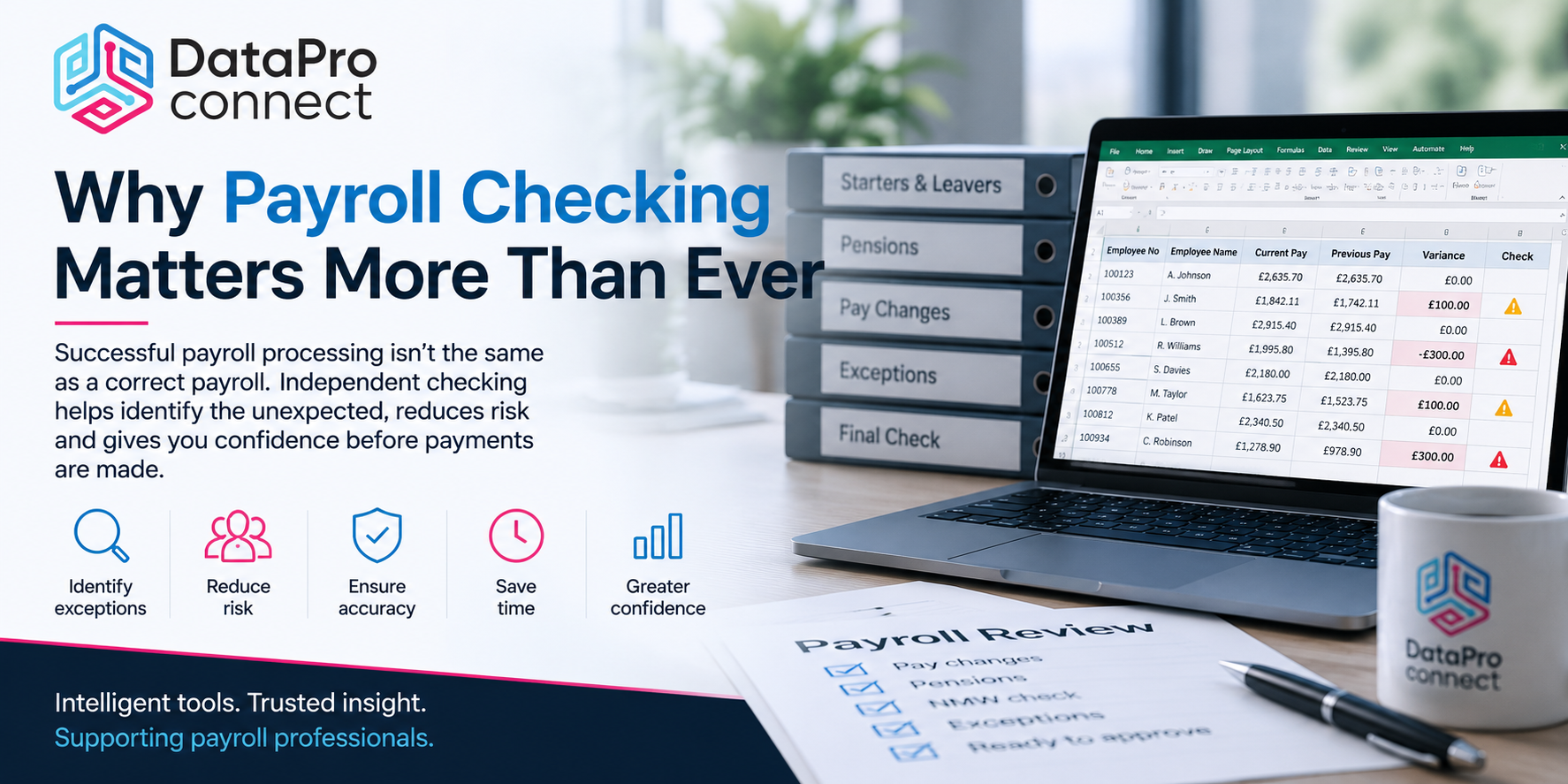
NHS Payroll systems process millions of employees, apply complex rules and calculations, and produce payroll results remarkably quickly.
But successful processing doesn’t necessarily mean that every payment is correct.
A payroll system can only process the information it has been given and apply the rules it has been configured to follow. Incorrect input, unexpected changes or unusual combinations of circumstances can still result in an employee being paid incorrectly.
That’s why payroll checking using DataPro Connect remains such an important part of the payroll process, especially in a large, complex organisation such as the NHS, the UKs largest employer.
Finding the unexpected
One of the challenges facing NHS payroll teams is the sheer volume of information involved.
In a large organisation with limited resources, manually reviewing every employee’s pay may not be practical or even possible. More importantly, it isn’t necessarily the best use of an experienced payroll professional’s time.
Effective payroll checking is about identifying the unexpected.
That might include:
- an unusually large increase or decrease in pay
- an unexpected change in pension contributions
- an employee approaching or falling below National Minimum Wage
- a payment or deduction appearing for the first time
- a significant difference compared with the previous pay period
- an employee whose expected payment is missing altogether
Individually, these circumstances may be perfectly legitimate. The purpose of checking isn’t to assume something is wrong; it’s to identify the transactions that deserve a closer look.
Payroll is constantly changing
No two pay periods are exactly the same.
Employees join and leave. Hours change. Pay awards are implemented. Overtime and enhancements vary. Absence affects pay. Pension circumstances change. Retrospective adjustments are processed.
At the same time, payroll teams must accommodate changes to legislation, organisational policies and national terms and conditions.
The more variables involved, the greater the value of having the right tools, and a consistent checking process that can highlight changes and exceptions before payroll is finalised.
Comparing this run with the last one
One of the most powerful ways to check payroll is also one of the simplest: compare it with what happened previously.
A single payroll result viewed in isolation may look perfectly reasonable.
Compare that result with an employee’s previous pay, however, and an unexpected change can become immediately apparent.
Period-on-period comparison allows payroll teams to concentrate on what has changed, rather than repeatedly checking information that has remained exactly the same.
This principle can be applied across thousands of employees, turning an enormous volume of payroll data into a much smaller and more manageable set of exceptions.
Automation doesn’t replace payroll expertise
Automated payroll checking isn’t about allowing software to decide whether somebody has been paid correctly.
There are simply too many circumstances where professional judgement is required.
Instead, good automation performs the repetitive work: comparing records, applying checking criteria, identifying unusual results and presenting them clearly.
The payroll professional then decides whether an exception represents a genuine problem or a perfectly valid change.
That distinction is important.
Technology finds the exception. Payroll expertise explains it.
Finding problems before they become pay errors
The best time to identify a problem is before the employee receives the money.
Once payroll has been finalised, correcting an error can involve considerably more work. The payroll team may need to contact the employee, arrange an additional payment or recovery, make adjustments in a subsequent payroll run and explain what happened.
There may also be consequences outside payroll itself, particularly where pension contributions, statutory deductions or other payments have been affected.
Finding a potential problem during payroll checking provides an opportunity to investigate and correct it before those additional complications arise.
Consistency matters
Good payroll checking should also be repeatable.
Relying entirely on an individual’s knowledge of what to look for creates risk, particularly during periods of absence, staff turnover or unusually high workloads.
A structured checking process helps ensure that the same core validations are performed each pay period, while still allowing payroll professionals to investigate circumstances requiring their experience and judgement.
It also provides greater confidence that unusual results haven’t simply disappeared amongst thousands of perfectly normal ones.
Better checking doesn’t mean more checking
The answer to increasing payroll complexity isn’t to ask payroll teams to perform more manual checks.
It’s to make the checking more intelligent.
By automatically analysing payroll results, comparing periods and identifying problems and exceptions, DataPro Connect can reduce the amount of information requiring human review while increasing the likelihood that something unusual will be noticed.
This has always been central to the DataPro Connect approach. Our solutions allow data analysis to be completed consistently and bring potential issues and problems to the fore, allowing payroll professionals to concentrate their time and expertise where it matters.
Payroll accuracy doesn’t have to be about checking more. It’s about knowing where to look. DataPro Connect makes that quicker and easier than ever.
If you would like to learn more about DataPro Connect and how our solutions can help your Trust’s payroll team, why not book a demo or get in touch? We are ready and waiting to hear from you.










Leave A Comment